Ciaran is a Melbourne-based journalist whose writing has been published by numerous outlets including The Guardian and The Age. His work has been recognised by the Walkley Foundation, Melbourne Press Club and the NSW Premier’s History Awards.
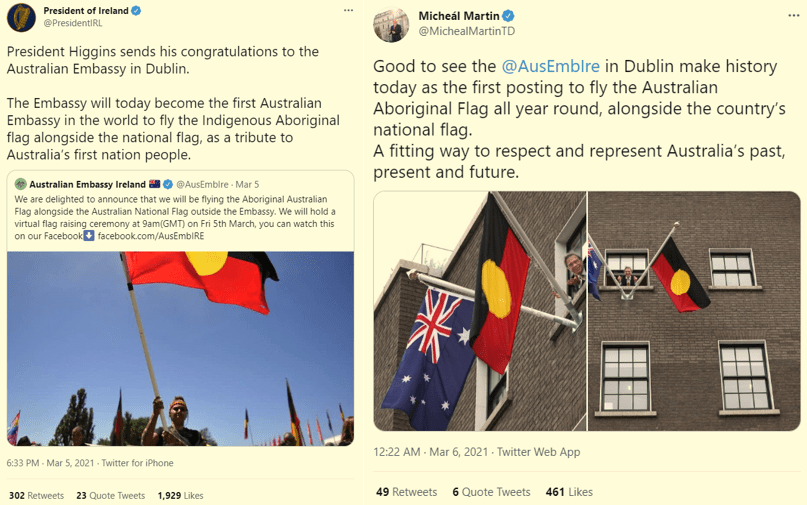
The Aboriginal Flag is flying permanently in the heart of Dublin after a historic ceremony at the Australian Embassy in Ireland.
The embassy became the first Australian outpost to fly the flag year round – side by side with the Red Ensign.
Australia’s Ambassador to Ireland, Gary Gray, described the flag raising ceremony as “a statement of cultural recognition and respect” and an “accepted and understood symbol of unity.”
The Official Aboriginal Flag raising ceremony at the Australian Embassy in Ireland (Dublin). Source: AEI Social Media
Many Aboriginal Australians living in Ireland, Australia and other countries, watched the digital ceremony. Some who lived within a 5 km radius of the Embassy were allowed to watch it in person under Ireland’s current Covid-19 restrictions.
The flags had previously been on display inside the Embassy and officials felt that extending that presentation to the building’s exterior would be a natural and significant progression.
“We spoke with various representatives of the Australian government in Canberra as well as members of the Aboriginal community here in Ireland,” says Ambassador Gray.
“This engagement enabled us to fully appreciate the importance of recognition for many Irish-Australian Aboriginal people and made the decision very easy,” he says.
Ireland’s President, Michael D Higgins, congratulated the Embassy, while their Prime Minister Micheál Martin praised the event, tweeting that it was “a fitting way to respect and represent Australia’s past, present and future.”
Gray has been heartened by the positive local reaction and feels it’s indicative of the strength of Australia’s relationship with Ireland.
“The response from across Irish society has been unbelievably supportive,” he says.
Closer to home, Shadow Minister for Indigenous Affairs, Linda Burney, said of the ceremony – “Australia’s First Nations heritage is – and rightfully so – a source of pride at home and abroad. It is wonderful to see the Australian Embassy in Ireland demonstrate this with this simple and humble gesture.”
Although he was in virtual attendance, Minister for Indigenous Affairs, Ken Wyatt, could not be reached for comment.
Aboriginal Activist and Academic, Mick Dodson, was delighted with the news, which had personal significance given his Irish heritage.
“I’m very stoked about the Aboriginal flag being flown over the Australian Embassy in Ireland,” says Dodson, whose Great-Grandparents came to Australia in the 1840s to escape the Great Famine.
“I’m very, very proud of my people, the Yawuru people, and I’m proud of my Irish ancestry.”
“There’s a strong connection between Aboriginal Australia and Ireland and there are many Aboriginal people of Irish descent in Australia,” Dodson says.
Professor Mick Dodson. Photo: Tracey Nearmy via Getty Images
Legendary artist Kev Carmody is another Aboriginal Australian with proud Irish roots. He believes the flag ceremony “reflects firstly and most importantly our Indigenous First Nations pride” and “represents cultural recognition and sovereignty on the International stage.”
Nevertheless, Dodson cautioned Australians to keep this gesture in perspective. “This is a wonderful thing that they’re flying the flag, but we shouldn’t lose focus. There’s a lot of hard work to be done yet.”
“We have to come to terms with that [colonial] past. We have to examine it truthfully and honestly, acknowledge it and do something about it – and then say this is the path forward, we’re going to repair that past for a better relationship in the future.”
Carmody agrees, stating that healing can only occur when Australia has fully confronted its dark past. “Pride for the richness of Indigenous Culture can be shared by all Australians and the rest of humanity if this is recognised,” Carmody says.
Greens Senator for Victoria, Lidia Thorpe, acknowledged that the ceremony was a positive step, but contrasted it with the lack of cultural recognition at home.
“Where the Australian Government continues to deny the Blak history of these lands, I’m really pleased to see that the Australian Embassy in Ireland has done what so many allies across this country are doing, taking matters into their own hands by proudly flying the flags of this country in their workplace,” Thorpe says.
“Meanwhile it’s a constant struggle to get this Government to even acknowledge the Aboriginal history of these lands, right here on this continent,” she says.
Thorpe highlighted that while the Aboriginal flag is being raised by Australian embassies abroad, motions to raise the Aboriginal and Torres Strait Island flags in the two houses of Federal Parliament have been rejected.
“I can’t say I was surprised when the Coalition Government recently voted down a motion to have the Aboriginal and Torres Strait Islander flags displayed in the Senate Chamber. It’s clear to me that they’re frightened of the truth, and of having their power and privilege challenged” says Thorpe.
Green Senator for Victoria, Lidia Thorpe. Photo: Imran Ariff and Ciaran O’Mahony
“Ours is the oldest surviving living culture on Earth. I commend the Australian Embassy in Dublin for taking this important step, and encourage other Embassies and organisations here and abroad to think about what can be done to show solidarity with the First peoples of this country.”
Sports Federations insist Covid-19 lockdowns won’t stop them catching dopers. But athletes are less optimistic, according to recent surveys.
The results of Global Athlete’s “Return to Play Survey” show that many international athletes are concerned their counterparts “will use this time to dope.”
The organisation’s Director-General, Rob Koehler, says the survey asked athletes about the effects of Covid-19 on their lives. Doping was top of their list of concerns.
“We heard from 375 Athletes from 23 countries representing all continents, and from 49 summer [Olympic] and 18 winter [Olympic] sports,” says Koehler.
“The majority of athletes were concerned with the lack of doping controls during the pandemic, while also indicating that they felt some athletes will take advantage of the lack of doping control,” he says.
“We recognize the sample base may not reflect the voice of the entire athlete community but it does give us some insight,” according to Koehler.
Of the 375 athletes surveyed, 63% identified as female, 36% as male and 1% as other. They have also competed at the highest levels of professional sport such as – 28% Olympic/Paralympics, 46% World Championships, 11% World Cups and 15% national competitions.
Here’s how they felt about doping control during the pandemic:
How concerned are you with the lack of doping controls during the pandemic?
19% Extremely concerned
25% Very concerned
21% Moderately concerned
14% Slightly concerned
19% No concerned at all
With the lack of doping control, how likely do you believe it is that some athletes in your sport discipline will be to use this time to dope?
25% Extremely likely
30% Somewhat likely
16% Neither likely nor unlikely
17% Somewhat unlikely
12% Extremely unlikely
These results follow the University of North Carolina at Greensboro’s study, which anonymously surveyed 1400 American athletes in 2020. Over 50% of these athletes believed their international competitors would take advantage of significant dips in doping tests during the Covid-19 pandemic. As many as 30% believed their compatriots would do the same.
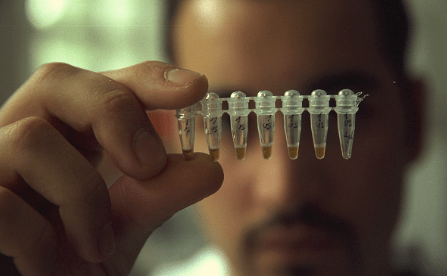
Photo: Julien Hekimian/Sygma via Getty Images
Despite these statistics, International Testing Agency (ITA) spokeswoman Marta Nawrocka insists their anti-doping program “is not a frail system that has come to a halt because of the effects of the pandemic.”
The ITA is leading anti-doping for the Tokyo Olympics, and is administering tests on a “country by country” basis to strike a balance between “public health first and anti-doping efforts second,” according to Nawrocka.
“Our absolute priority continues to be the protection of the health of all athletes and doping control personnel,” Nawrocka says.
“There were very few competitions taking place since past spring and so In-Competition testing numbers significantly dropped, we continued to implement our Out-Of-Competition testing program throughout the past year and continue to do so now,” she says.
“Periods without competitions or access to athletes for testing purposes will be taken into account once sports events start taking place again.”
Many international sports events have been cancelled or postponed since March 2020, causing a significant decrease of “in-competition” testing. Numerous out-of-competition testing missions were also suspended due to Government restrictions. This is evident in WADA statistics obtained by The Jaded Newsman, which show a nearly 50% decrease in drug testing last year.
Total Drug tests completed around the world. Source: WADA
But there was a testing resurgence in late-2020 and Ms Nawrocka says the ITA is pleased with their achievements given the challenges they faced.
“Overall, the drop in the out-of-competition testing numbers that we implemented for our partners in 2020 was less than 10%, which is a solid result considering the circumstances,” she says.
All mid-pandemic testing has been conducted using stringent sanitary protocols for athletes’ safety, according to Nawrocka.
“The current situation is definitely challenging and requires flexible approaches, but it does not mean that anti-doping actors are left empty handed. We still have a solid array of approaches to catch cheats,” she says.
These alternatives include risk assessment, intelligence, investigations, Athlete Biological Passport administration, Therapeutic Use Exemption management, results management and anti-doping education.
Olympic champion Callum Skinner isn’t surprised by athletes’ scepticism, but says we must give everyone the benefit of the doubt during this period, unless clear evidence emerges.
“Of course it’s a worry, testing rates have plummeted,” says Skinner.
The Scottish Cyclist, who won Gold and Silver Medals at the 2016 Olympics, has no doubt that doping occurs at the top level.
But he knows that many athletes compete clean and don’t deserve to perform under a cloud of suspicion as sports return.
“The system wasn’t water tight before and it isn’t now,” according to Skinner.
“I tend to stay away from accusing people with no evidence, we have plenty of confirmed cases to give our attention to that are mismanaged,” Skinner says.
“We’re in the unknown so I’d encourage people to measure their scepticism on a case by case basis,” he says.
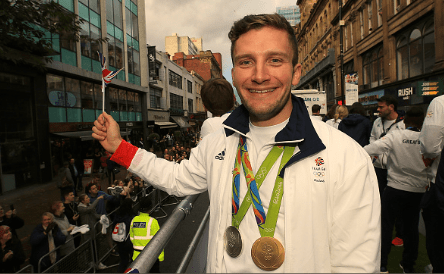
Callum Skinner celebrates his Olympic achievements at the Team GB victory parade. Photo: Jan Kruger/Getty Images
Fellow Cycling medallist Alexander Kolobnev is less concerned about pandemic doping.
Kolobnev finished in 4th place at the Beijing Olympics, but was later awarded a Bronze medal after Davide Rebellin was stripped of his silver medal upon re-testing of blood and urine samples.
Dopers have always been out there, according to Kolobnev, but the pandemic will not exacerbate the problem.
He says testing will increase significantly in the final 100 days before the Olympics and “stupid cheaters” will not be able to maintain “top shape”.
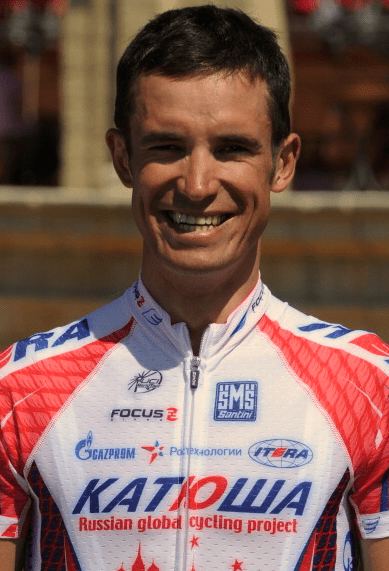
Russian Cyclist and Olympic Bronze Medallist, Alexander Kolobnev. Photo: Pascal Pavani/Getty Images
“[Doping] has sense only if you [are] competing and not sitting in [a] sofa or do[ing] your virtual races,” Kolobnev says.
“Of course there will always be 1-4% of crazy or weak athletes who could use prohibited substance[s] or methods, but they always were,” he says.
“It’s part of the game. Find them and kick them out.”
As anti-doping bodies continue to adjust to Covid-19 restrictions, testing gaps and blind spots are increasing.
Rob Heffernan is an Olympic Bronze medallist, but he has never stood on the coveted Olympic podium.
At London 2012, years of grinding through Ireland’s damp, scenic landscape drove Heffernan to a 4th place finish in the 50 km race walk.
He had fallen agonisingly short of Olympic glory. But rumours swirled that the man who took Gold – Sergey Kirdyapkin – was part of a state sponsored doping program.
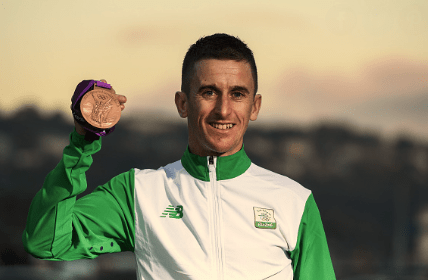
Four years after returning to Ireland empty-handed, Heffernan was awarded Olympic Bronze in a special ceremony at City Hall, Cork. Kirdyapkin had been stripped of his title after failing multiple drug tests.
Rob Hefferan finally receives his Olympic Bronze medal in November 2016. Photo: Stephen McCarthy/Sportsfile via Getty Images
“To take a medal for Ireland in front of Buckingham palace was such an incredible feeling. It was great to take something back for the injustice that we have suffered over time by wrong doing. A small victory, [but] nonetheless a victory,” Heffernan says.
While his heroic performance in London was eventually rewarded, Heffernan is in little doubt that he’s been cheated out of other major honours.
“I have suffered more throughout my career to dopers,” Heffernan says.
“There are [other] medals and better positions that I should have now but there is nothing I can do about it.”
He tries not to dwell on these injustices as they will inevitably lead to anger and misery.
“You would be angry and frustrated as your life can be drastically different when your results are better on paper. I try not to waste too much energy thinking about these negative scenarios,” he says.
But with the Tokyo Olympics looming, sports fans could be forgiven for wondering if Covid-19 lockdowns have allowed ‘drug cheats’ to thrive.
Sport has rightly been scaled back as we’ve battled a virus that has taken over 2.1 million lives to date. But pandemic restrictions have also forced National Anti-doping Organisations (NADOs) to limit or completely suspend doping tests for extended periods.
The Jaded Newsman obtained WADA’s latest international testing figures – and they are alarming.
WADA Anti-doping Tests – 2019 vs 2020
2019
2020
Jan
17,539
20,286
Feb
23,819
25,257
Mar
26,933
11,206
Apr
25,219
577
May
27,146
2,625
Jun
26,904
7,706
Jul
28,084
11,080
Aug
29,360
14,612
Sept
26,638
18,697
Oct
26,897
21,081
Nov
26,469
19,554
Dec
20,873
15,078
Annual Total
305,881
167,759
In 2019, 305,881 blood and urine samples were collected by NADOs around the world. But in a pandemic hit 2020, they collected just 167,759.
From March to August 2020, monthly testing figures were over 50% lower than the previous year. In April and May, in particular, there were 97.8% and 91.4% dips.
Although testing increased in subsequent months, it was consistently lower, and more lockdowns in late 2020 and early 2021 have further weakened doping operations.
Numerous NADOs told us their testing had been significantly effected:
Doping Authority Netherlands’ testing has dropped by 40% during the pandemic and with all sports except football currently suspended there, the situation is unlikely to improve any time soon.
National Anti-doping Agency (NADA) Germany have maintained strong out-of-competition testing, but in-competition testing has taken a major hit. There was a complete suspension of all testing from mid-March to mid-May 2020.
The Canadian Centre for Ethics in Sport (CCES) didn’t test their athletes from March 27 to July 13 (resumption of urine collection) and October 26 (resumption of blood collection). Three quarters into their fiscal year, testing numbers are one-third lower.
The Australian Sports Anti-Doping Authority’s* (ASADA) annual report for the 2019/20 financial year showed a 20% fall in testing on the previous year – from 5,523 samples to 4,414. However, state lockdowns extended well past this timeline.
The United States Anti-doping Authority (USADA) is yet to release lockdown testing figures, but they reduced their operations to “mission critical testing” during the Spring of 2020, while United Kingdom Anti-doping’s (UKAD) April-June figures show an almost 95% drop from 2019 (2,212 to 126 tests).
*ASADA was replaced by Sport Integrity Australia at the end of the financial year
How will this affect clean sport?
President of Doping Authority Netherlands, Herman Ram, says “the impact of Covid-19 on our testing program has been, and still is, huge.”
Ram cautions that it would be unfair to assume that athletes are taking advantage of reduced testing, but he concedes that he “would prefer to have more proof to support this.”
USADA CEO, Travis Tygart, knows that many athletes were doping before the pandemic and he has no doubt that some will view this period as a window of opportunity.
“The temptation to dope rises when there is a less likely chance of being caught due to known, reduced testing,” says Tygart.
Travis Tygart, President of USADA. Photo: John Thys/AFP via Getty Images
Studies have shown that minor doses of PEDs taken during “off-peak” periods can be undetectable in urine or blood samples a year later. But they can provide performance-enhancing benefits for up to 4 years.
For example, the most common PED detected by NADOs is anabolic steroids. A study by Scientists at the University of Oslo suggests that these substances can provide muscle boosts that potentially last for decades. Athletes would therefore reap the benefits long after the steroids were detectable in their system.
Drug Free Sport New Zealand CEO, Nick Paterson, is concerned that the problem may have intensified, but stresses that the vast majority of athletes will not be swayed one way or the other by recent events.
“The lower amount of testing in 2020 certainly means that both detection and deterrence has dropped off,” Paterson says.
“However, just because a storekeeper turns her back or takes a call when you’re in a shop, does not mean you immediately start stealing their goods, does it? Most people have better ethics than that,” he says.
Some research suggests that many don’t. Olivier de Hon, Harm Kuipers and Maarten van Bottenburg conducted a comprehensive review of academic studies on the prevalence of doping up to 2015. Their review found that between 14-39% of anonymously surveyed athletes were doping – much higher than the 1-2% who failed drug tests during this period.
Another study conducted randomised response surveys of 1,203 athletes at the IAAF World Athletics Championships (South Korea) and 965 athletes at the Pan Arab Games (Qatar). They revealed that over 30-43% of the WAC athletes had admitted to doping within the last 12 months, with over 45-57% of the PAG athletes doing the same. The findings were so controversial that their publication was blocked for 6 years.
Photo: Patrik Stollarz/Bongarts/Getty Images
While it’s clear that many athletes were already doping. The question is, has that number increased? And could the impacts on testing help them get away with it?
Paterson highlights certain barriers to entry regardless of athletes’ intent.
“If you have been a clean athlete and prior to 2020 were not doping, where would you suddenly get supplies from and how?”
“Purchasing prohibited substances is not as easy as placing an on-line grocery order,” says Paterson. “Many of the athletes doping during this period are therefore likely to have already been cheating or well on the path to do[ing] so.”
Sport Integrity Australia (SIA) CEO, David Sharpe, holds a similar view – “Athletes willing to cheat or win at any cost will always look for ways to cheat, whether that be through advancement in science, unethical practices or during periods where testing may be limited.”
NADA Germany says the uncertainty around the return of competitions could result in immediate and unexpected spikes in testing, making it extremely difficult for athletes to schedule comprehensive doping programs in lockdown.
“PEDs are only relevant if you train for a goal. As many competitions are cancelled and athletes do not know when testing is back. Out-of-competition schemes are in place and will start without any further notice. The unpredictability of the system is a decisive advantage for testing authorities,” they say.
WADA spokesman James Fitzgerald says major physical gains are also unattainable due to the closure of training facilities.
“Most performance-enhancing drugs work in conjunction with high-quality, strenuous training and, with COVID-related restrictions and lockdowns in place, many athletes do not have access to their normal training facilities. This mitigates the risk of athletes deciding to cheat.”
Nonetheless, NADOs hope to resume blood and urine testing at previous levels ASAP.
In most cases, that won’t be possible for some time, but New Zealand is a rare exception. From mid-March to June 10 – and briefly in August 2020 – they had a strict lockdown and testing was suspended for 11 weeks. Nevertheless, they collected 1,061 samples by the end of the financial year, against a target of 1,350 samples.
But countries like The Netherlands are up against it, according to Mr Ram. “We will be in lockdown for at least another four weeks,” he says.
“Once the lockdown is ended, it will still take some time to restart them [and] our government is discussing a curfew.”
NADOs have emphasised that drug tests are not the only tool available to catch dopers. They have invested significantly in anti-doping education programs, and intelligence/whistleblower investigation teams – to catch drug cheats who are beating the tests.
“Any effective anti-doping program cannot be reliant solely on testing,” says SIA’s David Sharpe.
He explains that Intelligence helps NADOs decide:
Which athletes to test and when to test them
Which sports are most at risk of doping
What emerging substances pose a threat to athlete health and sport integrity.
David Sharpe, CEO of Sport Integrity Australia. Source: Sport Integrity Australia, Facebook page.
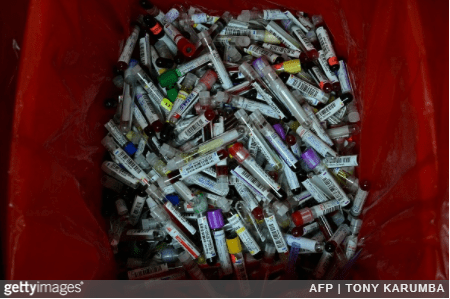
Athlete Biological Passports (ABPs) are another crucial weapon. They are developed through a sequence of tests that provide longitudinal biological profiles of each athlete. ABPs provide a specific reference range for key biological variables in athletes’ blood and urine and can therefore detect unusual results even when PEDs are no longer in an athlete’s system.
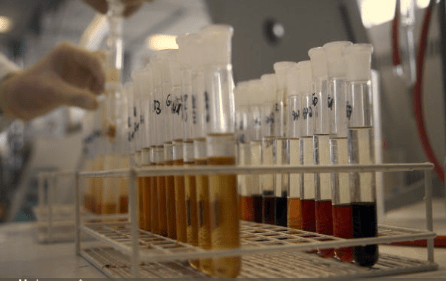
The storage and re-analysis of long-term blood and urine samples will also help to uncover irregularities in the future, according to the Australian Olympic Committee (AOC).
“All athletes would be very familiar with the IOC’s re-testing program which has proved successful in back-capturing drug cheats by using new technologies to detect past infringements,” says the AOC.
“The AOC doesn’t believe drug cheats can take any comfort from the impact of the pandemic on anti-doping programs.”
As a beneficiary of re-testing, Rob Heffernan has a clear message for athletes who might be tempted to dope during this tumultuous period.
“Athletes need to know if they cheat, they will be caught. And if you do cheat, I feel if its conclusive, you should be banned for life – no second chances.”






 The Jaded Newsman