
By Ciaran O’Mahony
James Noble became Australia’s first Aboriginal Deacon at the height of the frontier wars.
Whilst Aboriginal people were being routinely murdered, dispossessed and enslaved, Noble found himself an unlikely, yet respected religious figure.
So how did he get there?
It might seem unusual for a traditional Aboriginal man to work for the Anglican Church, but Noble’s Great Granddaughter says he didn’t have much choice.
Badtjala and Bidjara woman, Tabatha Saunders, says “the colonials were hell bent on indoctrinating the ‘savages’” back then.
“I think he saw the way of the ‘whites’ as a portal for him to win what was really a losing battle for our people,” she says.
“If he could glide under the radar, and ‘assimilate’, he would be able to help communities in his own way.”

Rev. James Noble performing a christening at the Forrest River Mission a year before the massacre, 1925. From the State Library of WA collection, courtesy of Wilma and Harry Venville
Noble did just that, spending his youth working as a stockman in Riversleigh in the early 1890s, before moving with his employer to Invermien, New South Wales.
“He was well regarded as a good worker and as a teenager he asked to be educated. The people who owned the cattle station sent him to school. From there, he ended up in Invermien and was given private lessons,” Saunders says.
He was baptised at St Luke’s Anglican Church (NSW) in 1895, before moving back to Queensland to work as a Missionary for Revered E.R. Gribble.
As a Missionary and a Reverend (ordained in 1925), he travelled to Aboriginal communities from Palm Island to Broome, working tirelessly to help them build a brighter future. But he couldn’t do it alone.
During his travels, he was fortunate to meet a Badtjala woman named Angelina Bradley at Yarrabah Mission, Queensland.
Angelina’s journey to Yarrabah was a harrowing one. Born in K’Gari (Fraser Island), she was removed from her traditional homeland and sent to Cherbourg Mission.
Sadly, at just 14 years of age, Angelina was abducted by a horse dealer, who took her to various parts of Queensland and sexually abused her, according to Saunders.
“She was kidnapped, disguised as a boy and used as a sex slave by a pedophile,” says Saunders.
She shudders at the thought of her Great Grandmother’s ordeal – “[Being] stolen and then taken all around Queensland by this kidnapper. She was a kid for God’s sake”.
Eventually, Angelina and her captor were discovered by Police in Cairns, who freed her and sent her to Yarrabah – where she met James.

Angelina Noble (far left) with Rev. Noble (2nd from the right) and their family at the Forrest River Mission, 1925. From the State Library of WA collection. Photographer: Wilma and Harry Venville.
Angelina thrived at the Yarrabah school and would later marry and travel the country with James.
Together, they helped to found churches throughout Northern Australia and assisted the Mitchell River and Roper River Missions. They constructed houses, sheds and horse yards, delivered supplies, and cared for the sick and livestock.
Saunders feels that her Great Grandparents “beat them [white settlers] at their own game” by “keeping [Aboriginal] communities together” and spreading compassion and understanding.
Although their connection to the Church gave them some freedom and standing, the Nobles’ work and travels were not without risk.
Such was the disregard for Aboriginal life at the time that an anonymous column in the Sunday Times (March 30, 1902) noted there were “cut-throat” men throughout the Kimberley who felt “the taking of a n*****’s life was of no more consequence than the drowning of a superfluous kitten.”
Politician George Simpson even declared at the WA Legislative Council that “…it will be a happy day for Western Australia and Australia at large when the natives and the kangaroo disappear.”
Historian Dr Chris Owen confirms that “it is clear in voluminous historical records that the white colonists really didn’t even see them as human.”
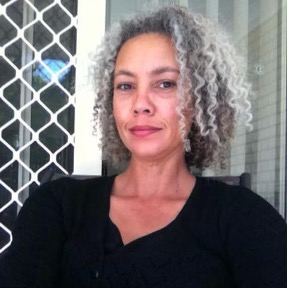
Tabatha Saunders, James and Angelina Noble’s Great Granddaughter. Photograph: Provided.
Nevertheless, James and Angelina persisted – and prevented many acts of violence that would have led to Aboriginal slaughter.
In The Reverend Ernest Gribble and Race Relations in Northern Australia, historian Christine Halse describes Rev. Noble as a dignified leader, whose reassuring presence was sorely needed at punitive Anglican Missions. Although he was not the Superintendent, Aboriginal residents saw Noble as the Mission’s “boss”.
“James’ ability to hold the Aborigines’ attention made him an invaluable preacher,” Halse writes. He was “admired and appreciated by the local tribes” and helped to prevent multiple incidents of violence between settlers and First Nations people, by communicating empathetically with both sides.
An Aboriginal woman called Lovie Kiuna told Halse of one such incident, where Noble, his wife Angelina, and a group of white missionaries, came upon an Aboriginal clan at a creek near Yarrabah:
“The river… [was] just black with Aboriginals…just watching them. Wild people…They didn’t want to see those white people cause they never saw white people in all their lives. Then [James] got up and stood at the fore of that boat. When they saw him they all put their spears down. That was that and they were all calm when they saw this…black man and he told them ‘my wife is black too but she’s half-caste’…They were satisfied with the wife too…and they all put down their spears…”
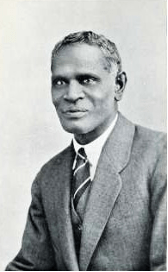
A portrait of Rev. Noble. Source: Tabatha Saunders FB page.
Angelina, was also instrumental in overseeing the daily care and wellbeing of Aboriginal residents at each mission. She was an important role model for young girls too, enjoying an independence that was extremely rare for Aboriginal women at that time.
In his book White Christ, Black Cross, Historian Noel Loos says Angelina’s role has sometimes been underestimated by historians.
“Because of the male domination of the Anglican Church during the nineteenth and twentieth centuries, Angelina’s role was often overlooked. She has been seen as James Noble’s support.”
“She was much more than that. Missionary women as nurses, teachers and housekeepers, interacted generally at greater human depths with Aboriginal people than most male missionaries,” he writes.
Angelina knew at least 5 Aboriginal languages and up to 14 different dialects, making her indispensable as they assisted displaced Aboriginal peoples across the country.
Her linguistic abilities also proved vital during their time at the Forrest River Mission – in WA’s East Kimberley.
Indeed, in 1926, a young woman named Loorabane arrived at the mission with a bullet wound in her leg and eyewitness testimony of police shootings of her mother and numerous Aboriginal people. She and her brother, Kangaloo, had managed to escape and sought refuge at the Mission.
These killings were carried out after the spearing of pastoralist Frederick Hay by an Aboriginal man called Lumbia, whose wife Anguloo, had been raped by Hay.
Police constables Graham St Jack and Denis Regan led a group of 11 armed locals in deadly shootings of anywhere between 30 to 100 Aboriginal people who lived at the Mission.
Angelina translated Loorabane’s and other residents’ accounts of the shootings to the head of the Mission, Reverend E.R. Gribble.
Gribble sent Rev. Noble – his best tracker – to investigate.
The stories were true. Noble followed a series of horse tracks and footprints from a small site in the East Kimberley ravine country, to a mound of ashy sand, where he uncovered numerous, charred human remains.
He also found makeshift ovens nearby, which had been dug up to burn Aboriginal victims’ bodies, and contained further bone fragments.
Noble’s discovery forced a Royal Commission into the killings, now known as the Forrest River massacre, with Angelina serving as the official translator at the trials.
Significant tampering with witnesses and evidence meant that the perpetrators ultimately walked free. Prosecution of Aboriginal murders was extremely rare and an Aboriginal couple being so prominent in the process was unprecedented. But it would have been little comfort to the Nobles after witnessing a great miscarriage of justice.
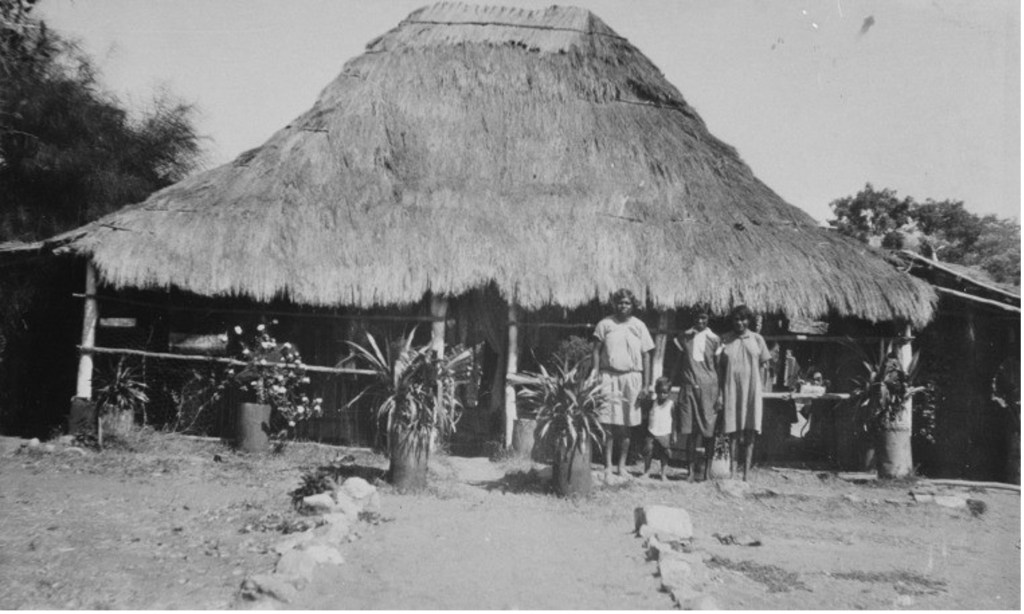
Rev. Noble’s House at the Forrest River Mission in 1925. Source: Frank Bunney Collection, State Library of Western Australia.
Still, as they had done throughout their turbulent lives, they pressed on. There was much more work to be done.
A year after the Royal Commission, 24 buildings, most of which had been built by James, stood proudly at Forrest River Mission. Many of these buildings still stand today.
Angelina taught the children and cooked for residents and staff, as the Mission’s population grew to 170.
The couple eventually returned to Yarrabah in 1934 as James’ health began to fade. He died on 25 November, 1941, while Angelina died much later on 19 October, 1964. They were survived by two sons and four daughters.
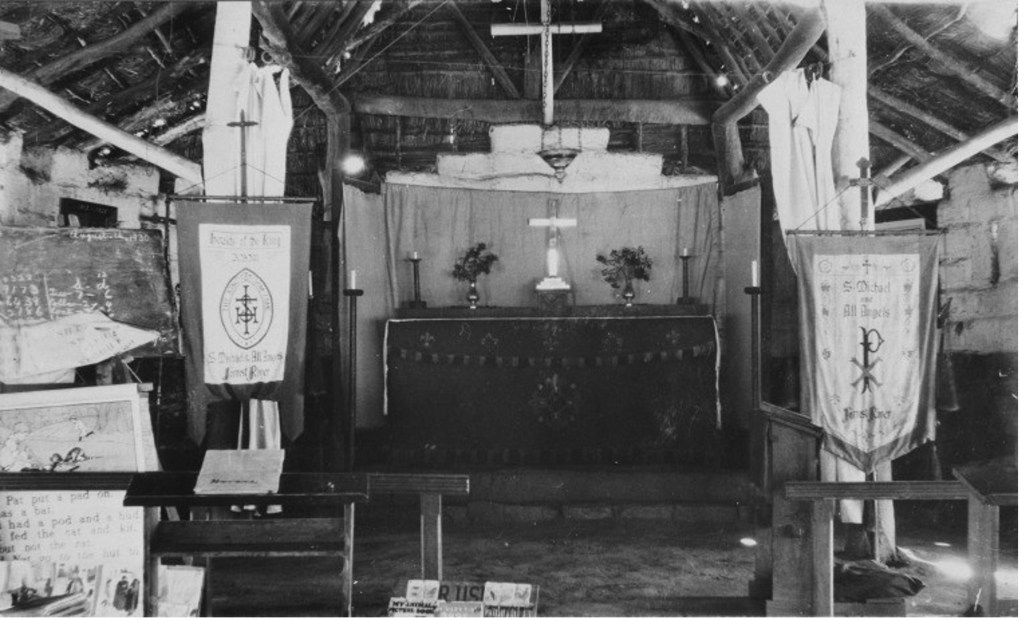
The Church where Rev. Noble preached at the Forrest River Mission, 1925. Frank Bunney Collection, State Library of Western Australia.
Tabatha Saunders feels the pride and strength of her ancestors every day, but she feels their resilience and resourcefulness, which is shared by many other Aboriginal Australians, is not highlighted enough.
Instead, harmful stereotypes persist. “I just find it sad that the racism against us is so ingrained. That we are lazy, we are alcoholics et cetera,” she says.
“It is hard as an Aboriginal person, to walk on this land and through its many countries and cities and still feel like an outsider. Fear is actually what I feel when I walk through this country,” says Saunders.
“I don’t always take on board the filthy stares and the sideward racism. But I feel them nonetheless.”
She plays her part in breaking down these stereotypes as the co-host of a radio program called “SoulJah Sistars”. The program raises awareness of the achievements of Aboriginal people and people of colour more generally, in politics, the arts and sport.
While there is still work to do, she is optimistic that a “rising tide of unity” is building.








 The Jaded Newsman